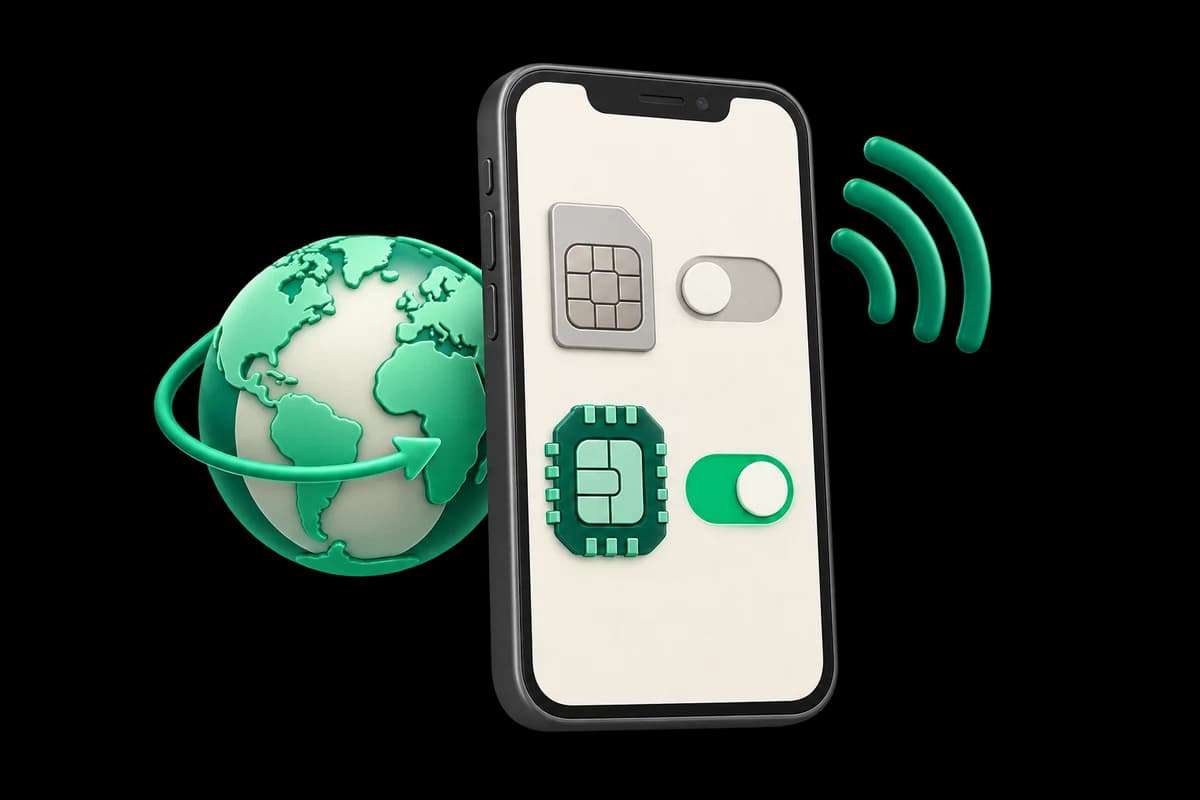
Installing a Thailand eSIM can start its validity, but the answer depends on the package. Thailand 100MB 7Days starts at installation; Thailand 5GB 30Days starts with the first connection to an eligible network. Do not apply “the days start when you arrive” to every product. Before preparing the phone, distinguish purchase, installation and connection, then check the start mechanism of the exact product you intend to use.
Separate the three events
Purchase gives you the package and its instructions. Installation adds the profile to the device. Connection uses an eligible network when the profile and settings permit it. Those events can happen at different times. The useful question is not simply how early you want to install, but which event starts the day counter for the chosen product.
The reviewed Thailand selection contains two mechanisms: activeType=1, starting at installation, and activeType=2, starting on the first eligible network connection. There is no single national behaviour established by these records. A similar code, smaller allowance or long installation window does not automatically change one mechanism into the other. Keep the product identifier with the instructions for your order.
Installation window and service validity are not synonyms either. These examples show a 180-day installation window, but seven or 30 days of service according to the product. That does not mean you can use data for 180 days. If installation starts validity, installing within the window does not prevent the counter from beginning. If connection starts validity, you still need to respect the installation window and instructions.
Our editorial recommendation is to note purchase date, start mechanism, installation date and first connection in the destination. You do not need to publish this note or the QR. It helps explain a question to support and check why an installed profile has not yet supplied data, or why the service period is already running before the next travel stage.
If you change the selected product, repeat the start-event check instead of retaining the assumption made for the previous variant. Comparing TH_0.1_7 with TH_5_30 is specifically a comparison of different allowances, periods and activation events. Keep the current order identifier next to the current instructions so that a saved screenshot from another product does not guide the installation. A smaller allowance is not a reliable shortcut for recognising the mechanism, and a longer installation window does not change the mechanism. These checks use the fields of the actual package rather than a general rule about Thailand.
Bangkok: prepare information before each online request
The pinned Wikivoyage article puts Bangkok at the beginning of many itineraries and names cultural places such as the Grand Palace, Wat Pho and Wat Arun. We use that context to organise concrete information needs, without presenting entry fees or opening hours. If the first stage is the capital, save the accommodation, arrival point and intended destinations before relying on cellular data.
The source describes boats as part of transport in different places, including river services in Bangkok. Keep the pier or meeting point named by your reservation instead of only the neighbourhood. Data can help check updated directions when service is available, but it does not establish reception at every point along a river. The boarding instruction remains a separate travel document.
Preparing the eSIM before departure does not require activating an installation-start product just to organise the route. You can save addresses and documents using reliable internet and arrange installation according to the mechanism and the trip. Information preparation and service activation are different tasks. Separating them lets you make the decision without urgency caused by missing documents.
Retain the names used on current reservations. The railway source illustrates why the actual Bangkok station on the ticket matters rather than a station assumed from the city name. We do not reproduce old dated search instructions or station changes as current advice. The transport operator's current document must confirm where your purchased journey starts.
Before leaving your first accommodation, open the saved next-stage information and check that it is readable without a fresh download. A bookmarked online account is not the same as a saved ticket or address. If a booking changes, keep the updated instruction with the correct stage. This is an observable preparation check, independent of whether you expect the eSIM to connect immediately.
A northern route needs more than the first connection
The source describes a railway network reaching Chiang Mai from the central part of the country and presents the city as a reference point for northern activities and cultural places. It also mentions regional mountain landscapes and itineraries. These descriptions do not establish uninterrupted reception on every train, road or activity. They help identify travel stages whose connection needs are different.
For Bangkok to Chiang Mai, retain the ticket, departure station, arrival station and accommodation separately. If continuing to another place, add that connection before leaving. The eSIM does not contain the ticket or prevent a reservation from changing. Check current transport information with the operator and keep a copy that can be opened without requesting it again.
For an activity outside the city, prepare the instructions supplied by its organiser. A saved meeting point is not a hiking guide or a mountain-coverage guarantee. If you need internet for work or a scheduled conversation, ask about service at the particular location. A country listing and technology field do not describe every connection in northern Thailand.
Match validity to the complete itinerary as well. A seven-day product does not restart when you reach Chiang Mai or change accommodation. If you installed a variant that starts at installation, days before the flight can be part of the elapsed service period. Check the order status before the next stage rather than inferring validity from signal bars alone.
Keep route and package information distinct in the same checklist. A confirmed train date answers when you travel, while the order answers when service begins and ends. If the route changes, review both. The existence of a railway connection does not certify mobile service along it, and a valid mobile package does not confirm a transport booking.
Ayutthaya, Sukhothai and routes with several stops
Wikivoyage identifies Ayutthaya and Sukhothai as former capitals and mentions Si Satchanalai and Kamphaeng Phet in the context of historic visits. We do not invent a duration for such a route. Each stop raises practical connection questions: where transport ends, how the accommodation is named, and which information must be checked after arrival rather than prepared beforehand.
Organise accommodation addresses by stage or stay date when visiting several places. That may be more useful than retaining a large amount of unstructured information. Saving maps and reservations is editorial preparation, not evidence that a particular route has or lacks service. A cultural description in the travel corpus must not be treated as a measurement of mobile infrastructure.
The source also places Khmer architecture in Isaan and cultural sites around Kanchanaburi. This destination variety shows why an eSIM guide need not consider only Bangkok and a beach. Check your real locations when the itinerary goes beyond those points. The operators for your package are those in its record, not a universal list applying to every region or every Thai product.
Beaches, islands and checking the line again
The source distinguishes Phuket, Ko Samui, Ko Pha Ngan, Ko Chang and the Krabi area, including Ao Nang, Rai Leh and Ko Lanta. We retain these names and their island or coastal context, omitting occupancy claims, fares and dated services. We have no measurements establishing coverage at every one of these places simply because the package includes Thailand.
The natural-landscape context also names Khao Yai and Khao Sok, along with limestone formations in Phang Nga Bay. These places broaden preparation beyond a beach hotel's address. If the itinerary includes an outing in a park or bay, retain the organiser's current instructions and the transfer details before departure. We do not use a pinned description to establish current access, excursion availability or reception within a natural area. Distinguish the overnight address from the activity's start and return points. This makes an operator query specific and keeps useful information available without presenting a country package as certification for every landscape visited. Check which documents belong to each point and keep the current instructions rather than an older itinerary image. The activity information and the eSIM order answer different questions, even when both relate to the same travel day.
Before boarding, save arrival point, accommodation and next transfer. The corpus describes different boat types and island links, but an eSIM record does not therefore include onboard internet. Maritime or satellite services are not established for these examples. If transport offers Wi-Fi, availability and conditions belong to that service and cannot be inferred from a terrestrial data package.
After arriving on the island, check that the travel line remains selected. If signal appears without working data, retain the profile and review its settings. A disconnected part of the journey does not automatically pause validity or increase the allowance. One failed session does not demonstrate absence of service across the whole island. A useful support description includes place, time, device and displayed operator.
For a city, north and beach itinerary, do not choose only by the number of stages. Compare the total service period from its start event with your actual usage. We do not publish conversions from gigabytes into video hours, map days or numbers of photographs because those were not measured here. Applications and background tasks can produce different consumption for each traveller.
Three real packages with different start mechanisms
Thailand 100MB 7Days, identifier TH_0.1_7, contains 100 MB and seven days. Its record has activeType=1: installation starts the period. The installation window is 180 days. Operators are TrueMove H and DTAC. Hotspot is enabled as hotspotSupported=true, and traditional calls and SMS are excluded. These fields describe this variant, not every eSIM for the country.
Thailand 5GB 30Days, identifier TH_5_30, contains 5 GB and 30 days. It has activeType=2, starting at the first connection to an eligible network, and a 180-day installation window. It lists TrueMove H and DTAC, enables hotspot, and excludes calls and SMS. This separates installation from the first connection under the conditions confirmed by the actual order.
For a different allowance and period, Thailand 1GB 7Days, identifier TH_1_7, contains 1 GB and seven days, with activeType=2, a 180-day installation window, TrueMove H and DTAC, and enabled sharing. It also excludes calls and SMS. All three examples were reviewed on 8 October 2026. Compare the current listing before purchase; do not transfer a condition from a similar name to the product you selected.
The records show technology 3G/4G/5G and provider-reported routing HK. Those are not a speed guarantee or proof of a Thai IP address for every session. A blank fair-use-policy field means the snapshot supplies no policy text in that field, not unlimited data. The allowance and validity of each package remain real limits even when the device has a working connection.
What to do before installation and after arrival
Before installing, confirm compatibility, carrier unlock and start mechanism. Use reliable internet and the order's QR or manual details, keep the code private and retain the instructions. Apple and Google Pixel help locate line-management controls; menu names vary with the device and software version.
In an included destination, select the eSIM for cellular data and enable its roaming as instructed. Review the home line separately, disabling its data roaming and automatic switching where available. This does not guarantee absence of voice or other home-operator charges. Confirm the selected line before checking a page or opening an essential application.
If internet does not work, check included country, validity, allowance, selected data line and the order-specific APN. Do not use another package's APN. Retain the profile while completing checks; deletion, reinstallation and transfer are not universal solutions. The FAQ collects general steps, while current plans show the conditions of the product you intend to buy.
Questions about installation timing
Does saving the QR use validity days?
Saving instructions and installing the profile are different. The start event depends on the product: installation for TH_0.1_7, and first eligible network connection for TH_1_7 and TH_5_30. Check that installation remains within the stated window as well. The presence of a code in your files is not a substitute for the order's activation information.
Can I share data before the package starts?
These examples enable hotspot, but it requires an operational data connection. Installing a profile does not create usable data outside its destination or before it can connect. When sharing works, both devices use the same package allowance; there is no separate reserve for the computer.
Does moving to another island restart activation?
No island-change reset is stated in these products. Choose validity for the whole period from the start event. Loss of signal on a journey does not establish a pause either. Supplier top-up metadata alone does not justify a promise of a store top-up feature.
Does the same package work in the next country?
Check that country explicitly in the product. Thailand does not prove Vietnam or Malaysia is included. For another route, see the Vietnam north-to-south guide or Malaysia peninsula and Borneo guide. Their destinations and conditions need independent verification.
Sources, credit and scope
Geography and transport context is an edited English selection and adaptation of Thailand on Wikivoyage, revision 5268793, credited to contributors documented in the history. The corpus was curated by vincentss/enwikivoyage-retrieval-202605. Fares, schedules, old services, comparisons and rules requiring updates were omitted. This textual adaptation is distributed under CC BY-SA 4.0; brand graphics are excluded. The corpus is a pinned snapshot, not a guarantee of future conditions. Examples and preparation advice are editorial additions reviewed on 8 October 2026, complemented by eSIM Access activation and start-mechanism documentation. The English edition retains the question and scope of its Spanish companion.